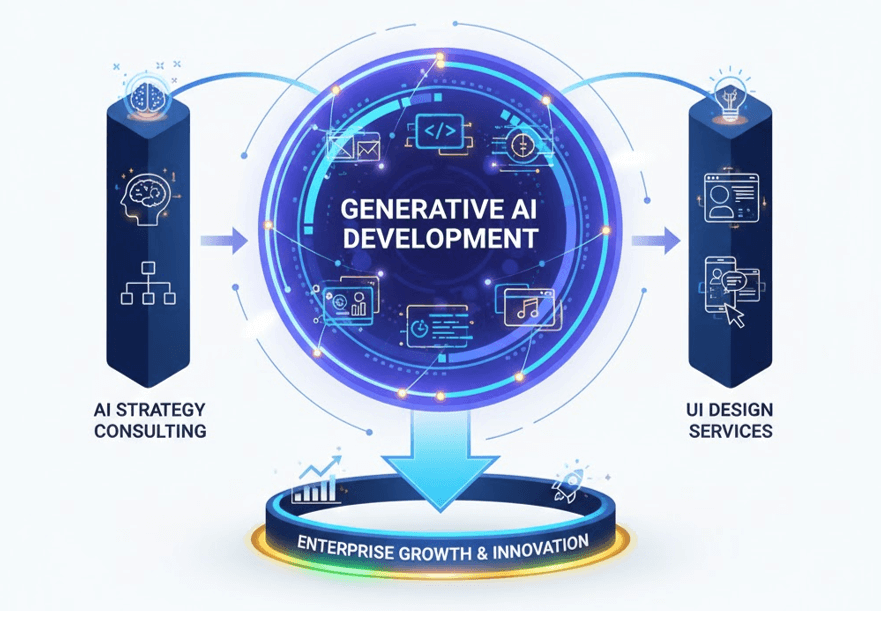
The digital business is no longer defined by its ability to store data, but by its capacity to generate value from it in real-time. We have entered an era where static applications are becoming obsolete, replaced by dynamic, self-evolving systems. At the heart of this shift are generative AI development services, which allow businesses to automate creativity, personalize customer journeys at scale, and streamline complex internal workflows.
However, the technical capability to generate content or code is only one part of the equation. To transform these capabilities into a sustainable competitive advantage, organizations must ground their innovation in expert AI strategy consulting and refine the experience through sophisticated UI design services. When these elements are integrated, generative AI ceases to be a novelty and becomes a foundational driver of business growth.
The Strategic Foundation: Why AI Strategy Consulting Comes First
The allure of generative AI often leads organizations to rush into implementation without a clear understanding of the architectural requirements or the business objectives. This “technology-first” approach often results in fragmented tools that lack security and scalability.
Professional AI strategy consulting serves as the critical first step in the development lifecycle. It provides the framework necessary to move from a conceptual “proof of concept” to a production-ready enterprise solution. A strategic roadmap focuses on:
- Identification of High-Value Use Cases: Determining where generative models can provide the most significant ROI, such as automated content generation or intelligent knowledge management.
- Data Privacy and Governance: Establishing protocols to ensure that the data used to train or fine-tune models is handled securely and ethically.
- Infrastructure Readiness: Assessing whether existing cloud environments can handle the computational intensity required by generative AI development services.
By leading with strategy, businesses ensure that their investment in AI is purposeful, measurable, and aligned with long-term organizational goals.
Building the Future with Generative AI Development Services
Once the strategy is defined, the technical execution begins. Modern generative AI development services focus on creating specialized models—often leveraging Large Language Models (LLMs) or Diffusion Models—that are tailored to the specific nuances of an industry.
Unlike generic, public-facing AI tools, enterprise-grade development involves fine-tuning models on proprietary datasets. This ensures that the outputs are not only accurate but also reflect the brand’s unique voice and operational standards.
- Automated Workflow Integration: Embedding generative capabilities directly into existing ERP or CRM systems to automate document drafting or data synthesis.
- Predictive Content Creation: Using AI to generate marketing assets, product descriptions, or technical documentation in real-time based on shifting market trends.
- Internal Knowledge Synthesis: Building “intelligent twins” of company databases that allow employees to query complex internal documents using natural language.
UI Design Services: Making Intelligence Accessible
The most powerful generative model is ineffective if the user cannot interact with it intuitively. As AI takes on more complex tasks, the “interface” becomes the primary point of trust. This is where professional UI design services play a pivotal role.
Generative AI introduces unique design challenges, such as managing “hallucinations” (incorrect outputs) and providing users with clear feedback while the model processes data. Expert UI design services address these by:
- Conversational Interface Design: Crafting natural, fluid chat interfaces that feel human-centric rather than robotic.
- Contextual Prompting: Designing UI elements that guide the user to provide better inputs, leading to higher-quality AI outputs.
- Visualizing AI Logic: Creating transparent dashboards that show the user why an AI generated a specific recommendation, fostering trust and transparency.
By investing in high-quality UI design services, organizations ensure that their advanced AI tools are not just functional, but genuinely delightful to use, which is a key driver for internal and external adoption.
The Intersection of Strategy, Development, and Design
The true value of digital transformation is found at the intersection of these three disciplines. AI strategy consulting provides the vision; generative AI development services provide the engine; and UI design services provide the steering wheel.
For a forward-thinking organization, this integrated approach reduces the friction of innovation. It allows teams to experiment rapidly while maintaining a focus on the end-user experience. It also ensures that the technology remains “future-proof,” as the modular nature of modernized UI and AI architectures allows for easy updates as the field of machine learning continues to evolve.
Final Thoughts
Transformation is not a one-time event but a continuous evolution. Organizations that succeed are those that view generative AI development services as a catalyst for broader change. By grounding their efforts in a solid roadmap provided by AI strategy consulting and prioritizing the human experience through professional UI design services, businesses can scale with confidence, knowing their foundation is strong and their direction is clear.
FAQs
1. How do generative AI development services differ from traditional AI?
Traditional AI is primarily predictive or discriminative, meaning it categorizes existing data or predicts future trends based on history. In contrast, generative AI development services focus on creating entirely new content—such as text, images, or code—that did not exist before, enabling much higher levels of automation and creativity.
2. Why is AI strategy consulting necessary before starting development?
Without AI strategy consulting, projects often lack a clear ROI or fail to account for data security and integration challenges. Strategy ensures that your development efforts are focused on the most impactful business problems and that your infrastructure is prepared for the unique demands of generative models.
3. Can UI design services affect the accuracy of an AI model?
While UI design services don’t change the underlying algorithm, they significantly impact the quality of the “prompt” or input provided by the user. A well-designed interface guides the user to provide the specific, contextual information the model needs to generate accurate and relevant outputs.
4. Are generative AI development services secure for sensitive enterprise data?
Yes, when implemented through professional services. Unlike public AI tools, enterprise generative AI development services utilize private cloud environments and strict data anonymization protocols. This ensures that your proprietary information is never leaked into public training sets and remains entirely within your control.
See also: USA Civic Alert 3496828933 Official Public Bulletin
5. How long does it take to deploy a custom generative AI solution?
The timeline varies based on complexity, but a phased approach is common. Following an initial period of AI strategy consulting, a “minimum viable product” can often be deployed within 3 to 4 months, with continuous refinements made based on user feedback and performance metrics.